
.png)
Sunrise, Stories and Reflection: Sorry Day Vigil
- May 26
- 3 min read
Today is National Sorry Day, and SSR amplifies this year’s clear call: From Sorry to Action.
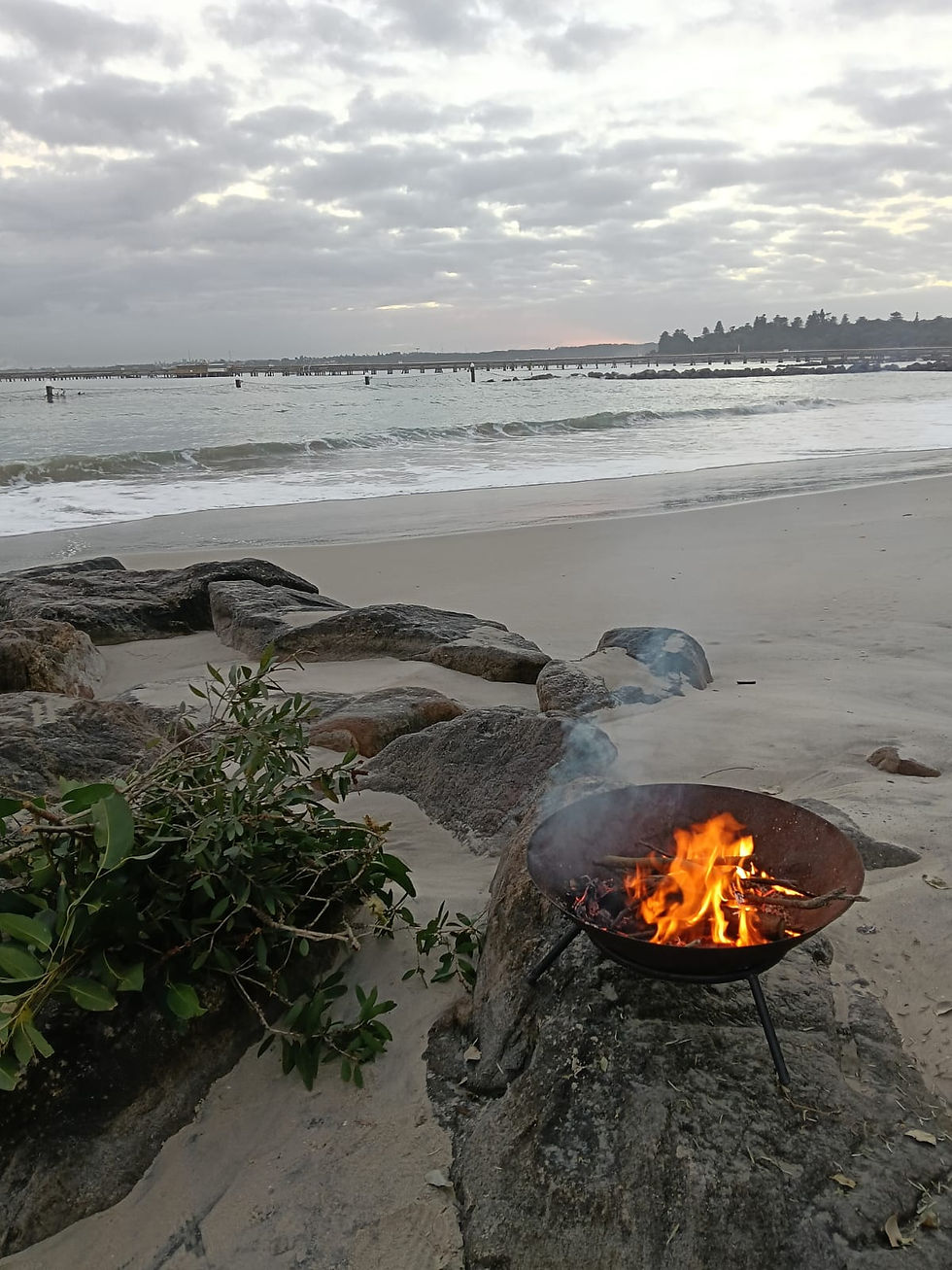
On Sunday morning, around 30 people gathered quietly in Kurnell for our sunrise vigil focused on reflection, truth-telling and reconciliation. With soft music playing in the background and smoke from burning leaves drifting gently across the shoreline, the gathering unfolded in a calm and deeply respectful atmosphere as the sun slowly rose over Dharawal Country - beautiful.
Five stories from the Bringing Them Home report were read aloud by non-Aboriginal participants, each recounting the experiences of Aboriginal children forcibly removed from their families under past government policies. After each story, the gathering paused for 30 seconds in silence.
Those quiet pauses became one of the most moving parts of the morning, allowing people time to reflect on each person’s experience and what it must have been like to live through those times.

At the conclusion of the readings, Chair of Sutherland Shire Reconciliation, Sonja Scherer, shared her own family’s deeply personal connection to the Stolen Generations.

She spoke of her mother, removed from her clan around the campgrounds of Darwin at approximately three years of age and taken into what was described as “care.” Her journey south was later documented in the book The 3000 Miles Journey. Eventually brought to Sydney, she remained in custodial systems until the age of 18 and, as Sonja described, effectively became an undocumented person within her own country.
Her mother never returned home again.
She remained disconnected from her family, culture and Country — separated from everything that would have formed her own identity, not the identity imposed upon her by government systems of assimilation. Years later, history repeated itself.
After having two daughters, both children were also removed at almost the same ages — Sonja at three years old and her sister at four to five years old.
Sonja remarked that they were removed for no other reason than their mother was black.
“She was a good mum and loved us — but that didn’t matter,” she said.
“We were ripe for assimilation.”
Sonja then delivered a call to action centred around remembrance, truth-telling and responsibility.
“We often hear the words, ‘lest we forget’,” she said.
“Traditionally, those words ask us to remember the sacrifice, hardship and courage of those who endured war and conflict. They remind us that remembrance is not simply about honouring the dead, but about learning from suffering and understanding the human cost when people are treated as expendable.”
She said those same words now carried meaning in relation to the Stolen Generations and Aboriginal history.
“Lest we forget must also mean that we do not turn away from the truth of what happened to Aboriginal children, families and communities.”
She called on those present to learn the history of the land they walk on, to listen when Aboriginal people speak about Country, family, water, trees and survival, and to question the idea that progress must always come through more growth, destruction and forgetting.
“The call to action is not guilt,” she said.
“It is responsibility. It is participation. It is choosing not to forget once the sun has risen and we all go home.”


Attendees remained gathered together along the shoreline for a long time before heading across the road for coffee, muffins, conversation and reflection as the morning sun spread across the sky. What had begun as a solemn service slowly transformed into something equally important — connection.
People stayed because they wanted to understand more share and just connect.
In many ways, those hours after the vigil became a demonstration of reconciliation itself — not as a political slogan or formal process, but as people choosing to remain present with one another, showing respect, listening deeply and wanting to connect.
The atmosphere throughout the morning remained warm, thoughtful and welcoming, with even the five dogs who attended adding a gentle calmness and comfort to the gathering.
In the quiet beauty of sunrise, smoke, stories and community, the Kurnell vigil became far more than remembrance. It became a living expression of reconciliation in action.


National Sorry Day, held on 26 May each year, is officially the National Day of Healing. It coincides with the release of the Human Rights "Bringing Them Home Report" released on the 26th of May 1997. It is a day to honour the strength, truth and lived experiences of Stolen Generations survivors and their families. We encourage you to visit the Healing Foundation to learn more about Acknowledging the Stolen Generations.


